


Understanding the Rules of the Pit Card Game
Just opened the box for the Parker Brothers Pit game and have no idea what to do with cards for ‘Wheat’ and ‘Barley’? You’ve found the right place. This is the game you often hear before you see it—the one that turns a quiet table into a room of laughing, shouting traders. It might look like pure chaos, but your mission is surprisingly simple: corner the market. That’s just a fancy way of saying you need to be the first person to collect all nine cards of a single commodity. To know more, check out buta info
Forget waiting for your turn; in this game, everyone trades at once. It’s a fantastic ice-breaker precisely because it gets everyone energized and engaged immediately. This guide breaks down the simple rules of the Pit card game and will get you playing your first round in the next five minutes, from dealing the first hand to slamming your cards down and yelling “Corner!” to win. Ready to join the trading floor?
What’s the Goal? How to “Corner the Market” and Win a Round
Unlike many card games where you might be building poker hands or taking tricks, Pit has one single, frantic goal: be the first player to collect all 9 cards of the same type. That’s it. Your entire focus during a round is to gather a complete set before anyone else can.
The different card types you’re trying to collect are called commodities. Think of them like the suits in a standard deck, but instead of Hearts or Spades, you’ll be chasing down sets of Wheat, Corn, Oats, or Barley. While the different commodity card values matter for scoring later, your immediate goal is just to pick one and collect them all.
When you finally manage to get all 9 cards of a single commodity—for example, all 9 Wheat cards—you have officially won the round. This is called “cornering the market.” Trying to corner the market while everyone else is trying to do the same thing at the same time is what creates the game’s exciting chaos.
These simple instructions boil down to that one objective: get a full set of 9 matching cards and yell “Corner!” to win the round. Now that you know the goal, it’s time to deal the cards and learn how.
Game Setup: How to Deal the Cards for Any Number of Players
Before the shouting begins, a little prep work is needed. The key to setting up the game is to make sure the number of commodity sets in the deck matches the number of people playing. If you have four players, you’ll use four full sets of commodity cards (like Wheat, Corn, Oats, and Barley). Each player’s goal is to corner one of these markets, so the math has to be just right. This is the most important step for a smooth game!
To build your deck, simply find all 9 cards for each commodity you need and put the rest back in the box. Here’s a quick guide:
- 3 Players: Use 3 commodity sets (e.g., Wheat, Barley, Corn)
- 4 Players: Use 4 commodity sets
- 5 Players: Use 5 commodity sets
- …and so on, all the way up to 8 players.
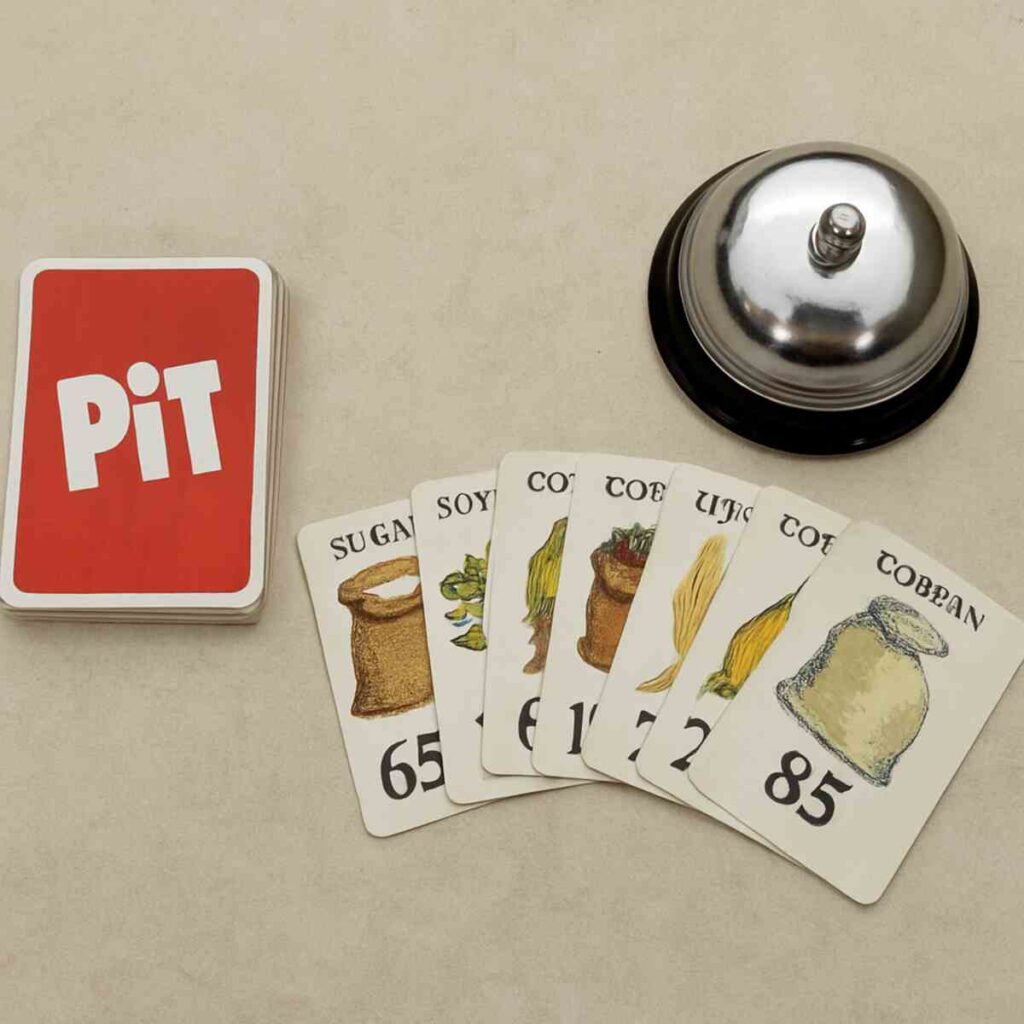
Once you have your deck ready, pick someone to be the dealer. Their job is simple: shuffle the selected cards thoroughly and deal the entire deck out. Every single card should be dealt, so each player will have a hand of exactly 9 cards. Finally, place the bell in the center of the table where everyone can reach it.
With cards in hand and the bell waiting to be rung, you’re ready for the main event. This is where you learn the most exciting part of the game: the trading.
The Heart of the Game: How to Trade Using “Open Outcry”
Unlike most card games, Pit has no turns. As soon as the cards are dealt, the round begins, and everyone starts trading at the same time in a chaotic free-for-all. This is called Open Outcry, and it’s what makes the game so loud and exciting. Your goal is to swap the cards you don’t want for cards you need, but you can’t just ask for a specific commodity. Instead, you have to trade in batches.
The key to the open outcry trading mechanic is the Trading Block. You can offer to trade one, two, three, or four cards from your hand, but they must all be for the same commodity. For example, you can decide to trade three Wheat cards, but you can’t offer a bundle of two Wheat and one Corn. This forces you to get rid of cards you don’t need while hoping to get something better in return.
The trading phase is a simple, four-step scramble:
- Choose Your Trade: Decide how many identical cards you want to get rid of (1, 2, 3, or 4).
- Shout Your Offer: Start yelling the number of cards you have. If you’re trading three cards, shout “TRADING THREE! THREE! THREE!”
- Find a Partner: Listen for another player shouting the same number as you.
- Make a Blind Trade: Once you find each other, quickly swap your bundle of cards facedown. You don’t get to see what they are giving you until the cards are in your hand!
You’ll continue this frantic cycle of yelling and swapping, trying to collect all nine cards of a single commodity. People often ask, can you trade just one card in Pit? Yes, and it’s a very common move to get rid of a single stray card! As soon as your hand is complete, you need to act fast to win the round.
“CORNER!”: How to Win the Round and Stop the Trading
That moment of pure victory arrives when you look at your hand and see nine matching cards. The second you realize you’ve managed to corner the market, you must immediately stop the chaos. To do this, grab the corner bell (usually placed in the center of the table) and ring it loudly while shouting “CORNER ON WHEAT!” (or whichever commodity you collected). This single action brings the entire round to a screeching halt, freezing all other players in their tracks.
The sound of the bell is the ultimate signal. The instant it rings, all trading must stop. Hands off the cards! Any swaps that weren’t fully completed are now void. These clear instructions are crucial to avoiding arguments. If you find yourself playing a Pit game without the bell, the rule is simply to be the first person to slam your hand firmly on the table and yell “CORNER!” The key is creating one unmistakable signal that ends the round for everyone.
After you’ve declared your corner and silence has fallen, it’s time for the big reveal. You must lay your hand down, face-up, for everyone to see and verify your win. All players will quickly check to confirm you are, in fact, holding all nine cards of the commodity you claimed. If your hand is valid, congratulations! You’ve successfully won the round. Now you get to find out how many points your hard-earned commodity is worth.
Racking Up Points: How Scoring Works in Pit
Winning a round is exciting, but it’s the points that will ultimately win you the game. Not all commodities are created equal! Part of the strategy in the rules of Pit is knowing which sets are worth the most. Going after a high-value commodity like Wheat is a bigger risk, but the reward is much greater than it is for a lower-value one like Soybeans. This simple detail adds a fun layer of tension to every trade you make.
Figuring out your score for the round is the easiest part. The commodity card values are printed directly on the faces of the cards, so there’s no need to memorize anything. The player who successfully cornered the market earns the points for that commodity, while everyone else scores zero for the round. The standard values are:
- Wheat: 100 points
- Barley: 85 points
- Corn: 75 points
- Rye: 70 points
- Oats: 65 points
- Flax: 60 points
- Hay: 55 points
- Soybeans: 50 points
A single round rarely decides the winner. The real goal in Pit is to be the first player to accumulate 500 points over multiple rounds. Keep a scoresheet and a pen handy to track everyone’s running total. The first person to hit or exceed that 500-point mark is crowned the ultimate champion of the trading floor! Once you’ve mastered the basics, you can add even more chaos with the special Bull and Bear cards.
Adding Chaos: How to Use the Bull and Bear Special Cards
Once you’ve mastered the basics, you can spice things up by adding two special cards to the deck: The Bull and The Bear. While optional, these cards introduce a thrilling layer of luck and tension that can turn a round on its head in an instant. Understanding the Bull and Bear cards is key to enjoying the full, chaotic experience of this classic game.
Think of the Bull as your ultimate best friend. It’s a powerful wild card that you can use to represent any commodity you need. If you have eight Wheat cards and the Bull, you can slam your hand down and yell “Corner on Wheat!” because the Bull completes your set of nine. Holding the Bull is a massive advantage, making you a major threat to win the round at any moment.
On the flip side, the Bear is the one card nobody wants to be caught holding. The Bear is a penalty card. It can’t be used to complete a set, and if it’s in your hand when another player successfully corners a market, you lose 20 points for that round. This adds a frantic urgency to the trading, as players holding the Bear will desperately try to trade it away before the round ends.
The most important rule concerning these special cards is knowing when to add them. We highly recommend playing a few rounds without them first. Once you’re ready, simply shuffle them in. You trade them just like any other card—by including them in a trade of one—but you can never reveal what you’re passing. Getting rid of the Bear or acquiring the Bull without anyone knowing is one of the most satisfying moves in the game. With these game-changers in mind, here are a few smart moves for your first game.
3 Smart Moves for Your First Game: Beginner Strategy Tips
The bell rings, the room erupts, and a flurry of cards starts flying. In the middle of all that shouting, how do you go from simply playing to actually winning? While luck plays a big part, a little bit of smart thinking can give you a serious edge. These simple strategy tips will help you navigate the chaos and start playing with confidence right from your very first hand.
Your most important move happens before you even shout a number. As soon as you pick up your cards, assess your hand and commit to a commodity. The best strategy is almost always to pursue the commodity you have the most of. If your starting hand includes four or more cards of the same type—say, Barley—your path is clear. Your goal is now to trade for the remaining Barley cards, making it much easier to corner the market.
However, a good plan requires flexibility. Pay close attention to what other players are shouting. If you’re desperately trying to trade a block of two cards but everyone else is only yelling “ONE!” or “THREE!”, you’ve hit a wall. Don’t be afraid to pivot! It’s often smarter to break up a smaller set of a different commodity to make a new trade than to stubbornly hold onto cards nobody wants. This adaptability is a core part of playing the game effectively.
Ultimately, the most successful Pit players are the ones who can think on their feet. Having a starting goal is essential, but knowing when to abandon it for a better opportunity is what separates a good round from a great one. Of course, even with the best strategy, some unusual situations are bound to pop up. What happens if two people yell “Corner!” at the exact same time, or if you run out of cards to trade?
What If…? Answering Common Pit Game Questions
Even the best strategy can be derailed by those tricky “what if” moments that pop up mid-shout. Every fast-paced game has them, and knowing the official ruling ahead of time keeps the fun from grinding to a halt. To keep the trading floor buzzing, let’s settle the most common debates before they even start.
It’s a photo finish—two players slam their hands down and yell “Corner!” at the same time. What happens in a tie? The winner is decided by the value of the commodity they cornered. Each commodity card has a point value printed on it (e.g., Wheat is worth 100, Corn is 80). The player whose complete set has the higher point value wins the round and gets the points.
But what about an overeager player who rings the bell without actually having a full set? This is a costly mistake. If a player calls “Corner!” incorrectly, they are out for the rest of that round. They must show their cards to the table to confirm the mistake, and then trading immediately resumes for everyone else until someone legally corners a market. This penalty keeps everyone honest!
Finally, don’t let a missing piece stop the game. If you’re playing a version without the bell, any clear, loud signal works. A sharp clap, a loud slap on the table, or even a designated “Buzzer!” shout gets the job done. While different versions and editions of the game might feature different commodities, these fundamental rules for ties and mistakes are universal. To keep these rulings handy, we’ve created a quick-reference guide.
Your Pit Game Cheat Sheet: The 60-Second Refresher
You’re no longer an outsider wondering what all the shouting is about—you’re ready to ring that bell yourself. All the rules of the Pit card game boil down to a few simple steps. To get your first game running in seconds, use this quick summary. Bookmark this section for an easy guide on how to play Pit during your game night!
- Setup: Use one commodity per player, then deal all 9 cards.
- Goal: Collect all 9 cards of one commodity.
- Trade: Yell the number of identical cards you want to swap.
- Win: Got all 9? Ring the bell and yell “Corner!”
- Score: Earn points based on your commodity. First to 500 wins!
You now have everything you need. These aren’t just instructions for beginners; they are your ticket to starting a loud, chaotic, and incredibly fun trading floor right at your own table. Go deal the cards and let the shouting begin.
